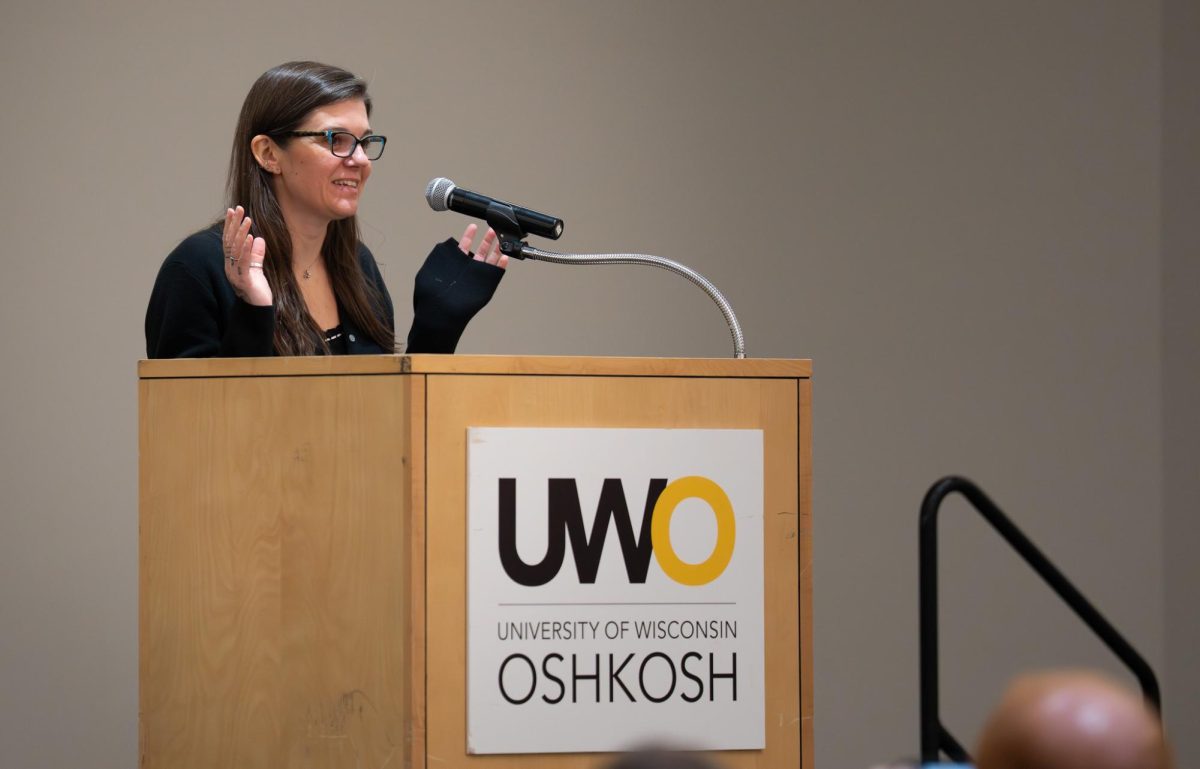
Bestselling author and activist Stephanie Land spoke to UWO students and the community about her past experience as a single mother persevering through poverty as part of the “When the Ends Don’t Meet” event at the Culver Family Welcome Center on Nov. 13.
But behind the story of her award-winning books and Netflix series “Maid” is the story of a single mom with a kid who lived through food and housing insecurity, working as a house cleaner, struggling to make ends meet.
“(In this) country we have historically lived by a myth that if you work hard and play by the rules and pull yourself up by the bootstraps, you are going to make it,” Land said. “Yet, currently, a single mother with two children earning the federal minimum wage of $7.25 an hour would need to work 252 hours per week … just to make a living wage.”
According to Land, estimates show that at minimum 1.2 million children in the U.S. public schools will experience some form of houselessness this year, with over 75% of these homeless families being headed by single women. The National Homelessness Law Center reports that violence against women is a leading cause of people becoming houseless.
Land said that about 2.2 million domestic workers who provide housekeeping, cooking, caregiving and other services are often seen as least valued and most vulnerable.
“The majority of these domestic workers are women, mostly women of color and who immigrated (to the U.S.) in the hope for a better life,” she said. “They take care of what is most important to us. … Yet, our society treats someone with a degree in higher education and a good-paying job with more dignity than someone cleaning restrooms.”
Land said prior to publishing her book “Maid,” she put out an essay about her experience being a house cleaner that reached 1 million clicks within days.
“I pissed off a lot of rich people with that essay, and I knew this because they told me in many colorful ways,” she said. “But I started to see that as people who hired house cleaners, they were actually the ones who were feeling exposed because I had forced them to see that the person who was in their house working was not just a human being but also a witness.”
Land recalls receiving thousands of messages from people who read her story of being a single mom living in poverty after she went viral on the internet.
“One person wrote to me, ‘Your story is my story, but my daughter’s name is Molly,’” she said. “Some sent me photos of their cleaning buckets and selfies with their grown children in a cap and gown, saying, ‘Well, I still work as a house cleaner, but I made sure my kid got through college, so they have a better life.”
Land said that she feels differently when people comment on her story as an example of “true resilience” and tell her to be proud of succeeding.
“When I lived in poverty, my anger and despair had no use or value,” she said. “I had no choice but compliance. I didn’t have the privilege to feel.”
The event, “When the Ends Don’t Meet,” also included two exhibits from UWO students focused on stories of people exploring the realities of poverty in the Fox Valley and current policies surrounding those issues. More than 50 students were included in the preparation of the display as part of their classes.
In UWO Professor Grace Lim’s “Telling Stories for Fun, Profit and World Peace” class, students partnered with Day by Day Shelter, the Oshkosh Area Community Pantry and the Tiny House Village to capture stories through interviews and photography.
Lim, an instructor in the university studies program and founder of the Humans of Oshkosh Storytelling Project, said that students received valuable experience while working on the exhibit.
“My students learned that meaningful storytelling starts with showing up and listening,” Lim said. “They saw that the people they interviewed aren’t defined by hardship but by strength and humanity. Those lessons will stay with them long after the semester ends.”
In Amber Lusvardi’s class, “Sex, Power and Policy,” students had an opportunity to explore how policy shapes efforts to tackle poverty and interview elected officials and community leaders.
Lusvardi, an associate professor of political science, said that in her field of studies, people often look into the future to find ways to solve problems in society, hoping students will do the same as an outcome of the efforts they put in the event.
“I would really hope … that (students) would take a moment to think about the future, like … what can we as individuals do to try to fix these problems in our community?” she said.
Land said that changes in poverty can happen when people start to share their stories with society accepting them.
“This is the only way that we’re really going to start to see change in this country … people sharing their stories with food insecurity,” she said. “By lifting up these stories of people with lived experience in the margins of society is when we will grow empathy and compassion … There are countless other stories just like (mine) that need to be told.”
The event was supported by the Speaker Series, the Center for Civic and Community Engagement and the Whitburn Center, with additional partnership from the University Studies Program, the College of Nursing and Health Professions and STEM and the School of Public Affairs and Global Engagement.