Wisconsin’s Missing and Murdered Indigenous Women Task Force has been in the process of releasing a comprehensive advising report on the epidemic of violence against Indigenous women since late 2020, but has yet to put forth the finished document.
Task force appointee and Brothertown Indian Nation member Renee Gralewicz said she worked to bring administrative attention to the matter long before the task force was established.
Eventually, the movement reached a point at which a bill was drafted and so Gralewicz and her peers traveled statewide to get eyes on the issue.
“I went to the Capitol, because the way the bills work in Wisconsin is you get a bill presented, then the legislature gives it to a committee,” Gralewicz said. “And the committee decides what to do with that.”
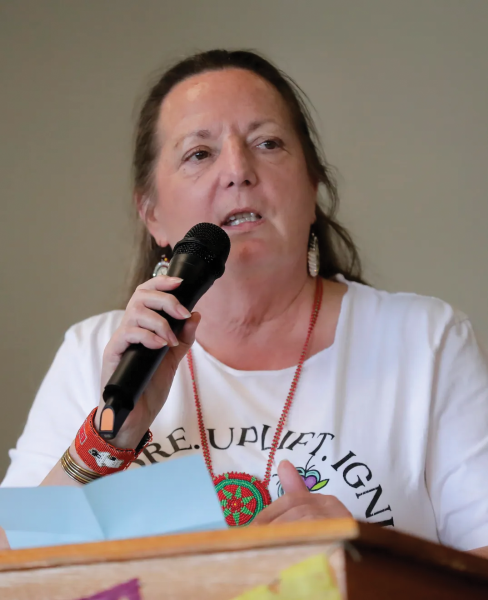
After meeting with the committee and lobbying legislators in preparation for a public hearing on the bill, Gralewicz and her peers were interrupted by the COVID pandemic.
“A lot of our public activism stopped,” Gralewicz said. “It didn’t mean that we stopped. We were still emailing, lobbying and calling It was the April of 2020 that the committee holding the bill in check said, ‘oh, we’ll have a public hearing now.’”
If a bill does not pass the committee following its hearing the whole process must be repeated, which was a concern for Gralewicz and her peers.
“You rewrite the whole thing, it gets put into a different committee, and you start over,” Gralewicz said. “This was COVID, so we weren’t starting over.”
She said the public hearing involved the testimonies of survivors of domestic abuse and the families of missing persons.
“Our legislators thanked us for our time, our blood, our sweat, our tears, and proceeded to do nothing,” Gralewicz said.
However, the public hearing connected Gralewicz and her peers with Wisconsin Attorney General Josh Kaul, who relayed the willingness of the DOJ to create a task force.
“I was hesitant,” Gralewicz said. “A number of us women talked about it on the side, and we decided, well, something’s better than that.”
By 2021, over 45 members joined the task force, including retired law enforcement, legislators, social workers and tribal representatives.
Members were divided into areas of expertise, with Gralewicz being policy, meaning their shared duty was to examine policies and determine what was relevant and necessary for Wisconsin.
Task force members believed the report to be nearly finished once their work wound down in 2023, Gralewicz said.
“We started to put it together and I believe it was in March 2023, we were going to present this to the governor, to the legislature,” Gralewicz said. “We were having a whole rollout thing, and it came to a dead end.”
The leaders of the task force asked for clarifications on some portions of the bill so the task force continued working for about another four or five months. Come 2024, Gralewicz said she heard nothing. She emailed the DOJ in September 2025 after another period of silence.
“I was given, ‘oh, we’re working on the report,’” Gralewicz said. “‘If you want to talk about it, call me.’ And I said, ‘no, I don’t want to call you. I want the report.’”
Other members who were not leaders of the force were also in the dark on progress, and those who emailed separately said they were met with similar vague statements according to Gralewicz.
Her colleague was finally able to get a definitive reply, which explained the delay as a matter of the report being ready for a public meeting. The DOJ said they were polishing it but only had three people working on the final report, all of whom were unwilling to share its current state.
Gralewicz said that two of the three parties were members of the task force, one being a leader and that the third was one of Kaul’s staffers.
“They did all their work, and all of a sudden, Attorney General Josh Kaul turns over the draft report they worked on and gave it to one of his other staffers so that could be rewritten in his voice,” Gralewicz said.
Gralewicz and her colleague called the department about the issue to receive more context and Kaul shared his intention to only release the recommendation portion of the report.
“You can’t do a recommendation without the story being behind it,” Gralewicz said. “No, the story needs to be told. So we’re fussing with him about that, and he listened to us. But that doesn’t mean we convinced him.”
After another meeting held regarding the issue, Gralewicz, Kaul and his staff agreed to disagree on the best way to release the report.
Gralewicz said that Kaul’s insistence on writing the report to cater to legislators and lawyers made him a cultural broker, one who translates these issues to make them easier for lawmakers to understand.
“That doesn’t mean his voice is stronger and more important than ours,” Gralewicz said. “So, that’s where we are. They’re working on it. Since 2023, when the report was 70% done.”
Despite their efforts being halted on the legislative level, they’re using other ways to address the epidemic of violence against Indigenous women.
May 5 is Missing and Murdered Indigenous Women and Girls Awareness Day, a day dedicated to demanding action to prevent further violence and loss of life on a mass scale for Indigenous women and girls nationwide.
In the spirit of this movement, Gralewicz shared ways for students to show their support.
“Ask other people, are you aware of the missing and murdered indigenous women epidemic going on,” Gralewicz said. “Also, you can write to Attorney General Josh Kaul.”
To reach Attorney General Kaul and inquire about the report, use either of the following contacts: or www.joshkaul.org/contact-us.