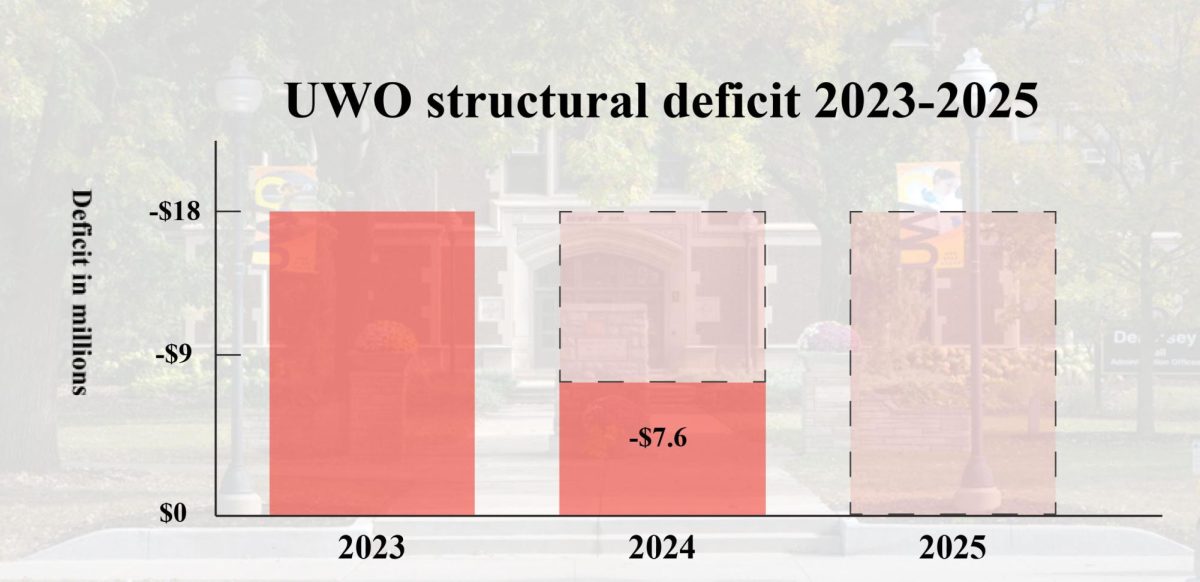
UW-Oshkosh announced at its State of UWO forum Feb. 10 that the university has climbed out of an $18 million budget deficit and Chief Operating Officer Corey Finkelmeyer said that the school ended the 2025 fiscal year with a positive balance of $5.3 million.
“The reasons for this improvement have been well discussed over the last couple of years,” Finklmeyer said. “Institutional Realignment Plan (IRP)1 and IRP2 yielded significant savings for our campus and put us on much more stable ground. Importantly, the (Universities of Wisconsin) just notified us of its budget to actuals report, showing our position as of December 2025. We are pleased to say we are tracking lower on our expense side and are aligning with where we should be as of December.”
Former UWO Chancellor Andrew Leavitt introduced the first IRP in 2023 to combat an $18 million structural deficit induced by dropping enrollment rates and COVID-19. Leavitt utilized 200 non-faculty layoffs, voluntary retirement, hiring freezes, a 2% budget cut and introduced furlough periods to cut expenses for the 2023-24 academic year.
UWO Provost Ed Martini rolled out plans for “UWO 2.0” in the same year, restructuring the academic colleges and departments while combining other areas such as the Department of Residence Life and University Dining. By splitting the university into the College of Business, Arts and Communication, the College of Public Affairs and Education and the College of Nursing, Health Professions and STEM, UWO reported a savings of $1.75 million.
Leavitt, who officially stepped down as chancellor on June 30, 2025, announced last March that the university would outsource University Books and More, which operated in a $1.5 million deficit, to the Follett Corporation in order to save costs for UWO.
Current Chancellor Manohar Singh, who took over for Leavitt on July 1, 2025, said that given where the university was a few years ago, he sees a path to resurgence.
“I see that path being carved by you all,” Singh said at the State of UWO forum inside Reeve Memorial Union. “Building the bridges, breaking the silos, being innovative, looking at what your job that you day after day do, and how does that relate to student success, student enrollment, fiscal stability of the university, our reputation, our brand, our care that we are known for and success of our alumni.”
UWO Faculty Senate President Nathan Stuart said that the faculty appreciate the renewed energy and optimism that Singh has brought to the university community.
“We hope he continues to increase the inclusion of faculty voices and expertise and the transparency of administrative decisions as he builds new programs for our learners and new relationships with alumni, employers and community leaders,” Stuart said.
At the forum, Finkelmeyer reported that the university’s 2023 fiscal year balance was $5.1 million before dropping to -$1.3 million in 2024 and increasing to over $5 million last year.
According to former University of North Carolina – Greensboro Provost Jim Coleman, a university can have a structural deficit while also reporting a positive balance at the end of a fiscal year.
Coleman said in a blog post on his website that this occurs when the university has a long-term, underlying mismatch where recurring spending commitments exceed expected ongoing revenue yet still possesses a “positive balance” due to temporary, one-time cash inflows.
“So, in the sense of having actual budget deficits, structural budget deficits are not necessarily a problem, especially if universities make sure to make good predictions of every revenue source at the beginning of the year,” Coleman said in January 2024. “A big flaw that I found when I was provost was that many latched on to the idea that only tuition and state appropriations are predictable enough to be permanent revenue. I don’t think that is true.”
Finkelmeyer said that the university is taking a multi-pronged approach to remaining stable financially.
“First, and most importantly, we are being disciplined in our position control,” he said. “Every open position or proposed new position is put through a rigorous review before approval. Maintaining restraint and being strategic in what positions we fill is the cornerstone of sustaining fiscal discipline.”
Finkelmeyer said that UWO is looking to increase revenue wherever possible, such as maintaining enrollment levels, and cutting non-personal expenses.
“All vendor contracts and travel are under review as part of our plan to maintain a stable budget,” he said. “Moreover, we continue to work together on strategies to achieve real-time utilities savings.”
UWO’s undergraduate enrollment has dropped for the last nine years and last fall, the university totaled under 9,500 students. In the fall of 2016, UWO recorded 11,012 undergraduate students.
In September 2025, the Advance-Titan reported that UWO was one of five Universities of Wisconsin to see a decline in total enrollment but still sits third among the state schools with 12,457 total students.
Martini said that the university has been working to flatten the rate of decline, which sat between 4-7% for the last seven years but is projected to be between 1-2% in the spring.
“A little look at spring, as we were in fall, there are a lot of positive signs to point to,” Martini said. “We have more first year students starting with us in the spring. We have more new transfer students starting in the spring. We have more new graduate students starting with us in the spring. So even though the overall enrollment is still dipping a little bit because we are still losing more continuing students than we are adding new students, we are on our path, as you’ll see in a moment, to full stabilization and being poised for enrollment growth.”
Singh said that he realizes that there are challenges to current enrollment numbers, but his team is working to create a positive trajectory.
“I don’t see in these numbers of strategic planning and enrollments and revenue generation numbers, despite my being a finance Ph.D. and all that,” Singh said. “I see these faces and I can identify and I can tell you that the work that you do is so meaningful, so impactful that you and I cannot even fathom the impact, and the ripples that will go for generations to come.”