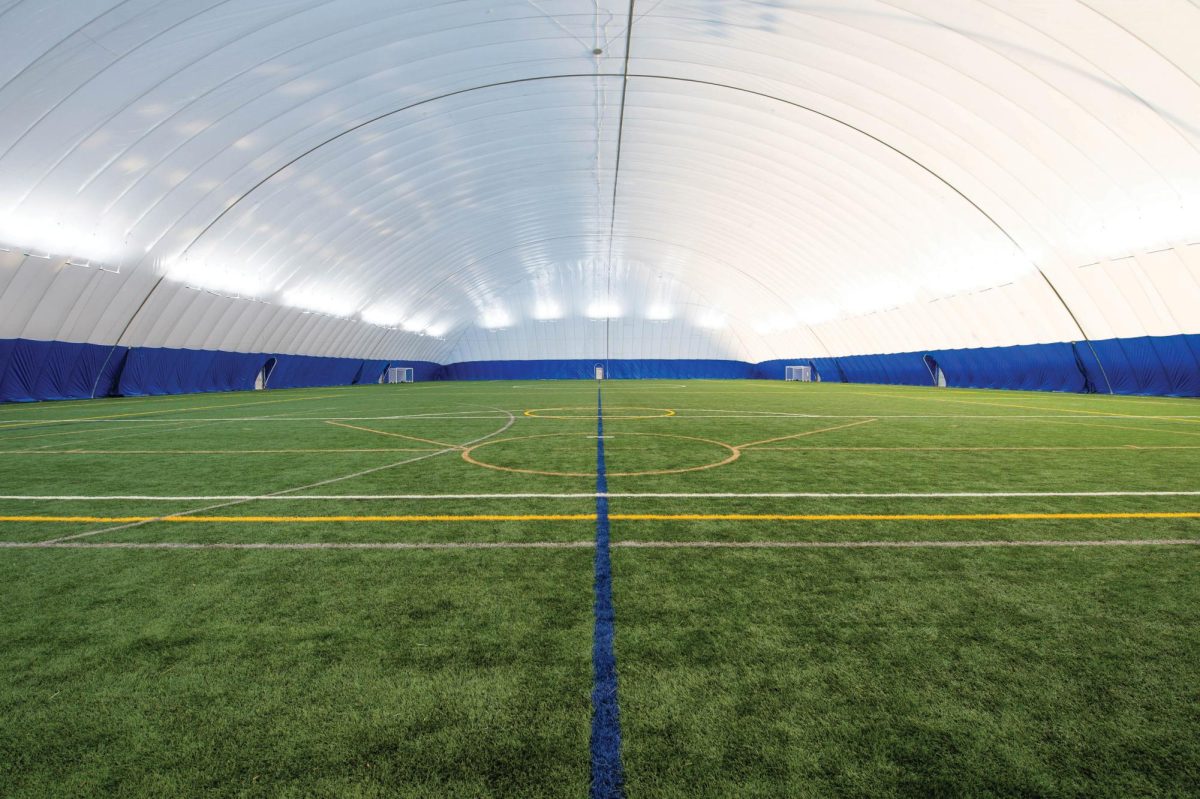
Former UW-Oshkosh Chancellor Andrew Leavitt announced in August 2024 that the Rec Plex Dome would be taken down over budget concerns, but eventually reversed the decision in response to major backlash following the initial announcement.
Over 18 months later, the dome, known as “the bubble,” remains just as large an expense to the university.
Several communications to and from Leavitt regarding his decision to take down the dome were made available in response to an open records request, with many showing a common grievance over a lack of communication prior to the announcement.
Gregory Batten, the associate director of student recreation, confronted Leavitt via email on Aug. 31, 2024.
“What I am appalled at is that at no point have any Student Rec staff, or our Director of Health and Wellness, been directly made aware of the decision,” Batten said in his email. “And most importantly, offered even a hint at a timeline.”
Maris Heun, a student athlete on the women’s soccer team since she was a freshman, said that she, along with many other student athletes on campus, were equally upset.
“We organized a protest outside of the Culver Center on the morning of an important staff meeting,” Heun said. “We lined up outside the doors with signs and chants to exercise our free speech and show the facility that we were against this decision.”
According to the university budget information received via an open records request, “the bubble” was facing a deficit of $467,733 at the end of fiscal year 2024.
That deficit came after the university took cost-saving measures, such as abandoning the original intention of deflating and reinflating the dome every summer in 2022.
Since 2018, the net income of “the bubble” has fallen deeper into the negative every year except for 2024 when, according to UWO Budget Director Jennifer Borgmann, a refund from a project on the Recreation and Wellness Center for around $141,000 was mistakenly credited to the Rec Plex account.
That mistake was partially corrected in 2025, which increased “the bubble’s” deficit at well over $500,000 at the end of the fiscal year.
But the dome’s costs did not stop people from defending it, with Athletic Director Darryl Sims reaching out to UWO leadership to ask if taking down the bubble could be delayed.
“I am asking to wait until June so we can honor the commitments we have already made,” Sims said in his email on Aug. 30, 2024. “Is there a plan to help relocate the competitions and fundraising opportunities that may be lost?”
Amid the complaints, protests and many emails that followed his announcement, Leavitt convened with UWO leaders including Batten, Sims, and then-OSG President Jack Marotz to decide on the future of “the bubble,” with Leavitt and Marotz releasing a joint statement on Sept. 3 that the bubble was to stay up.
“Outreach from student government leaders and student-athletes in the last several days convinced us that we need more time to examine the facility’s use and sustainability,” they said in the statement. “We support the creation of a representative task force that will include administrative, student government, intramural sports and athletics representatives to assess its financial and environmental impacts.”
The task force was to be formed and in action by Oct. 1, 2024, with a deadline to deliver a recommendation on “the bubble’s” future by Dec. 1. Among those selected to participate in the group were Batten, who served as chair, Borgmann and women’s gymnastics coach Lauren Karnitz.
Borgmann was willing to clarify budget-related issues, but didn’t respond to questions about the future or sustainability of the bubble. Karnitz, when asked about her involvement with the task force, insisted that all questions regarding it needed to go through Sims.
“I am on it, it did happen, and there was a decision reached,” Karnitz said. “But it seems as though most people on campus don’t have the accurate information about it.”
Sims did not respond to multiple phone calls and emails inquiring about the findings of the task force. Batten, after receiving permission from the chancellor’s office to do so, shared the conclusions of the task force.
“Last spring, Chancellor Leavitt finally landed on keeping the bubble up and allowing our new chancellor the opportunity to decide the future of the facility,” Batten said. “Our recommendation was whether the bubble stayed up or was taken down, we need to look at a more permanent facility in its next chapter.”
Batten said that “the bubble’s” lifespan likely only has a few years left on it, so a new facility could be in the works sooner than many might expect.
“A goal would be to have a new facility ready to go whenever we reach the end of the bubble lifespan,” he said. “That’s a goal, but we’ll see what our leadership decides. It’d be an expensive under-taking so my guess is that many options for finding the money would need to be discussed.”
Batten said that being offered the opportunity to chair the committee was an honor that allowed him to fight for the best interests of the student body.
“I was grateful that Chancellor Leavitt allowed me to chair the working group,” he said. “The biggest win is if, as a campus, working together, we find a way forward that is a more permanent structure that is continued to be managed and shared well and that serves the needs and wants of our students.”
Heun agreed that “the bubble’s” costs are outweighed by the opportunities it provides students and the community alike.
“I have seen firsthand the benefits the bubble provides to student athletes, intramurals, clubs, and the community,” she said. “The bubble is almost constantly being used.”
While the exact future of “the bubble” and a potential new facility remains uncertain, Batten said that the top priority as they move forward must remain the same.
“Our campus has always been about students since I started working here,” he said. “So, no matter how it all turns out, keeping their voice and needs at the forefront is the most important part of this process.”